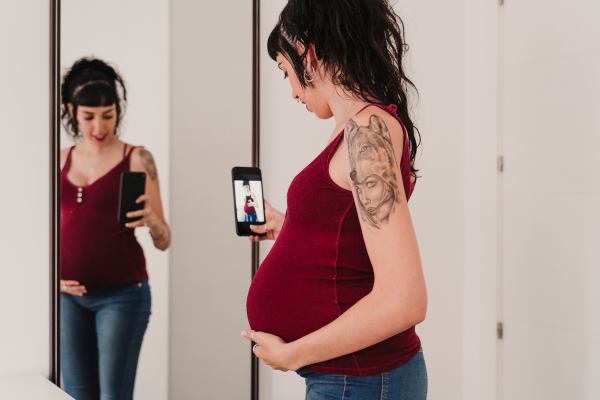
Why Baby Bumps Appear at Different Times and Why Variation Is Normal
What You Will Learn
- When most people start showing in pregnancy
- How first pregnancies differ from later pregnancies
- What actually causes a baby bump to show
- Why some people show earlier or later than others
- Why you may carry differently in different pregnancies
- Why belly shape can change daily or even hourly
If you have ever wondered,
- When do you start showing in pregnancy?
- Why am I not showing yet?
- Why are they bigger than me at the same week?
You are not alone.
For years, I hosted a pregnancy belly gallery that included thousands of submissions from pregnant people at every stage. What stood out most was not similarity. It was variation.
Two people at the same gestational week could look completely different.
The same person could look completely different from one pregnancy to the next.
That variation is normal.
Let’s talk about what actually affects when you start showing.
When Do Most People Start Showing?
There is no single week when everyone “starts showing.”
That said, here are general patterns.
8 to 12 Weeks
Most of what you see in early pregnancy is bloating.
The uterus is still tucked low in the pelvis. It is growing, but it is not large enough yet to create a noticeable bump for most people.
Some people feel bigger. That is often fluid retention and hormonal bloating.
12 to 16 Weeks
The uterus begins rising out of the pelvis.
Some people, especially in a second or later pregnancy, may begin to notice a visible change.
With a first pregnancy, many people still do not look obviously pregnant.
16 to 20 Weeks
This is when many first-time pregnant people begin to show more clearly.
Clothing may fit differently. The bump may look more rounded and less like general bloating.
20 Weeks and Beyond
By this point, most people have some visible sign of pregnancy. But even here, size and shape vary widely.
There is no universal timeline.
Why Do Some People Show Earlier Than Others?
Many factors influence when and how you start showing.
First Pregnancy Versus Later Pregnancies
In later pregnancies, abdominal muscles and connective tissue may stretch more easily. That can mean showing earlier.
But not always.
Core Muscle Tone
Stronger abdominal muscles may hold the uterus closer to the body for longer.
Looser or previously stretched muscles may allow the uterus to project forward sooner.
Uterine Position
A uterus that tilts forward may show differently than one that tilts backward.
Both are normal.
Height and Torso Length
A longer torso can give the uterus more room to expand upward before projecting outward.
A shorter torso may show earlier simply because there is less vertical space.
Genetics and Body Structure
If your family tends toward taller or shorter builds, that can influence how you carry.
Normal anatomical variation matters.
Bloating Versus Uterine Growth
In early pregnancy, hormonal bloating can look very similar to a baby bump.
It is common for people to feel larger at night and smaller in the morning.
That does not mean anything is wrong.
Multiples
Twins or higher-order multiples often create earlier visible growth, but even here there is variation. This is particularly true when you factor in the babies’ different positions.
The Same Person Can Carry Differently Each Time
One of the most powerful lessons from the pregnancy belly gallery was this:
The same person can carry completely differently in different pregnancies.
Higher. Lower. Wider. More forward. Less obvious.
Even with the same body.
After talking with thousands of pregnant people over the years, I can confidently say there is no single “right” way to look pregnant.
Almost anything is normal for any one individual.
The Emotional Side of Showing
This topic is rarely just about biology.
People compare.
They wonder:
Why am I not showing yet?
Why do I look huge already?
Does my bump mean the baby is too small or too big?
Social media does not help. Neither do comments from strangers.
Your bump size does not reliably measure baby health. Providers use fundal height measurements and ultrasound for growth assessment, not visual comparison.
Looking smaller or larger than someone else at the same week is usually about body structure, not baby wellbeing.
Why Your Belly Can Change Daily or Even Hourly
Late in pregnancy especially, your shape may change throughout the day.
In the morning, your abdomen may look smaller.
By evening, it may look fuller due to:
- Fluid shifts
- Digestion
- Muscle fatigue
- Baby repositioning
As your body prepares for labor, the baby may also shift lower into the pelvis. That can change how your belly looks.
These changes are common and normal.
Babies do not read clocks or calendars. Bodies do not follow social media timelines either.
Questions You Can Ask Your Practitioner
Is my bump size normal for this stage?
A reasonable answer might sound like:
We measure growth using fundal height and ultrasound if needed. Visual size alone is not a reliable indicator.
Should I be worried if I am not showing yet at 16 weeks?
A reasonable answer might sound like:
Many first pregnancies do not show clearly until later in the second trimester. We assess growth with measurements, not appearance.
Why do I look bigger at night?
A reasonable answer might sound like:
Hormonal bloating, digestion, and muscle fatigue can all affect how your abdomen looks throughout the day.
There is no single week when everyone starts showing.
There is only your body, your structure, and your pregnancy.
If you want practical, evidence based pregnancy education without pressure or comparison, you can subscribe to my newsletter below. My goal is to help you understand what is normal, what varies, and when something actually needs attention.